My partner is Eun Pyo.
Content
A storm has started and Casca is very scared of all the parts of a storm like lightning, thunder and rain. Casca describes that other weird things have been happening like men were on fire, a man put his hand in fire without getting burnt, a lion was at the Capitol and owls were hooting and shrieking in daylight. Casca believes that they are omens and that the gods are sending some sort of warning. Then Cassius then comes out the storm and explains to Casca that the gods were against Caesar and this is also the part where Cassius joins Casca into the conspiracy.
Significance of Passage
This passage is significant because it characterizes some characters and also sets a mood to the play. Casca is characterized as a scared and frightened, and is wary of omens. Since Casca is wary and believes that this is a warning form the gods, Cassius can easily put Casca in a state of mind that Caesar is the reason behins all of these weird occurences. Cassius does this by telling Casca that he offered himself to the gods to see if he was the trouble maker but because the gods didn't strike Cassius he proved himself innocent. This action immediatley gives Casca the idea that the true cause is Caesar even though it is a normal storm. This really characterizes Cassius as cunning and manipulaitve because he has turned Casca against Caesar in only a few lines. This can also charatcerize Casca as a gullible man. It also shows that Cassius has a lot of confidence in himself because he tells Casca is plan so quickly, not even taking his time or making sure that Casca was completly on his side. When Cassius says:
"But of Grief,
Where hadst thou led me? I, perhaps, speak this
Before a willing bondman; then I know
My answer must be made. But I a arm'd,
And dangers are to me indifferent."
This quote tells us that Cassius has purposely told Casca that he plans to kill Caesar and was so good at it, we know that Cassius is extremely confident and manipulative with people. The importance of this is that we've gone deeper into the character of Cassius which later on helps us notice how his character differs further into the conspiracy. Also when Cassius says:
"Now know you, Casca, I have mov'd already
Some of the noblest-minded Romans
To undergo with me an enterprise."
This quote ups the tension in the story. We've beem thinking that Cassius has just started gathering all the consprirators but suddenly Cassius is telling us that he's got some of he 'noblest-minded Romans" on his side which probably foreshadows that by having these types of people, Caesar will probably be killed. By knowing that there are more people against Caesar the tension goes up. Plus, this whole scence is about violent storms and weird things happening gives a scary mood and fear. There is a lot of imagery too especially when Casca decribes all the abnormal things which he saw and people saw. Altogether, this passage shows a lot of literary elements such as mood, characterization, foreshadowing and imagery.
Passage
Since the parts are in the same scene but are not together I would like to read out the parts that are most significant. I joined different parts together so it made sense. Hopefully I am allowed to do this.
Casca
"A common slave, wou know him well by sight,
Held up his left hand, which did flame and burn
Like twenty torches join'd; and yet his hand,
Not sensible of fire, remained unscorch'd.
Besides (I ha' not since put up my sword)
Against the Capitol I met a lion,
Who glazed upon me, and surly by,
Without annoying me. And there were drawn
Upon a heap a hundred ghastly women,
Transformed with their fear, who swore they saw
Men, all in fire, walk up and down the streets.
And yesterday the bird of night did sit,
Even at noonday upon the market place,
Hooting and shrieking. With these prodigies
Do so conjointly meet, let not men say,
'These are their reasons, they are natural';
For I believe, they are portentous things
Unto the climate that the point upon."
(Lines 15-32)
Cassius
You are dull, Casca, and those sparks of life
That should be in a Roman you so want,
Or else you use not. You look plae, and gaze,
And put in fear, and cast yoursel in wonder,
To see the strange impatience of the heavens;
But if you would consider the true cause
Why all these fires, why all these gliding ghosts,
Why birds and beasts from quality and kind
Why old men, fools, and children calculate,
Why all thesse things change from thir ordinanc,
Their natures and pre-formed faculties,
To monstrous state. Now could I, Casca name to thee a man
Most like this dreadful night,
That thunders, lightens, opens graves, and roars
As doth the lion in the Capitol;
A man not mightier than thyself, or me,
In personal action, yet prodigious grown,
And fearful, as these strage eruptions are.
(Lines 56-78)
Casca
'Tis Caesar that you mean, is it not Cassius?(Line 79)
Indeed, they say the senators tomorrow
Mean to establish Caesar as a king;
And he shall wear his crown by sea and land,
In every place, slave here in Italy.
(Lines 85-88)
Cassius
And why should Caesar be a tyrant then?
Poor man! I know he would not be a wolf,
But that he sees the Romans are but sheep:
Here no lion were not Romans hinds. (Lines 103- 106)
But, O grief,
Where hadst thou led me? I, perhaps, speak this
Before a willing bondman; then I know
My answer must made. But I am arm'd,
And dangers are to me indifferent.
(Lines 111-115)
Casca
You speak to Casca, and to such a man
That is no fleering tell-tale. Hold, my hand;
Be factious for redress of all these griefs,
And I will set this foor of mine as far
As who goes the furthest.
(Lines 116-120)
Cassius
Now know you, Casca, I have mov'd already
Some of the noblest-minded Romans
To undergo me an enterprise.
(Lines 121-123)
Friday, February 19, 2010

Saturday, November 21, 2009
Awesome Art
How can art be a mirror of Society?
Art is a very good mirror of society because it can reflect parts of different times and also cultures. When an artists paints a piece of artwork he doesn't just draw for fun but she/he always puts a purpose to them. For example, The School of Athens by Rapahel wasn't drawn because he felt like painting some men, he drew it to show that change and new knowledge was being taught and spread and that people from different cultures interacted with others. By painting it had given us an idea of how society has changed or how it was. Art is a mirror of society because all of the scenes of daily is painted. We have used pieces of art to study society. Also, artwork like The Birth of Venus by Botticelli shows how people started to think and show their new ways towards life and art. This painting shows that people started to return to old mythical characters or stories other than the church. Art is an excellent mirror and can reflect a lot about society.
The part of the painting that I would want to be is the man called Diogenes of Sinope. Diogenes of Sinope is the person on his own lying down on the stairs with the blue robes. I would like to be this part because he seems the type of person that likes to be laid back but at the same time gets on with things, this is because he is looking lazy but also doing his work (he is reading). This is exactly what I do in class and with my homework. I tend to take things easy but at the same time I am working. I also would like to be him, is because Diogenes is alone and to himself. When I am doing anything I usually like to be on my own or do things by myself. I can tend to get distracted while working in group projects or group discussions therefore I would prefer to isolate myself from all the commotion. Plus, I like to be the team leader, but at times it can be hard because usually people can be very stubborn and annoying. I prefer to take on leadership on in sports like football. To add, in the painting most of the small groups all seem to be listening to one person whereas Diogenes is by himself. I feel that I suit this part because it represents my mood towards work and other people.
Art is a very good mirror of society because it can reflect parts of different times and also cultures. When an artists paints a piece of artwork he doesn't just draw for fun but she/he always puts a purpose to them. For example, The School of Athens by Rapahel wasn't drawn because he felt like painting some men, he drew it to show that change and new knowledge was being taught and spread and that people from different cultures interacted with others. By painting it had given us an idea of how society has changed or how it was. Art is a mirror of society because all of the scenes of daily is painted. We have used pieces of art to study society. Also, artwork like The Birth of Venus by Botticelli shows how people started to think and show their new ways towards life and art. This painting shows that people started to return to old mythical characters or stories other than the church. Art is an excellent mirror and can reflect a lot about society.
The part of the painting that I would want to be is the man called Diogenes of Sinope. Diogenes of Sinope is the person on his own lying down on the stairs with the blue robes. I would like to be this part because he seems the type of person that likes to be laid back but at the same time gets on with things, this is because he is looking lazy but also doing his work (he is reading). This is exactly what I do in class and with my homework. I tend to take things easy but at the same time I am working. I also would like to be him, is because Diogenes is alone and to himself. When I am doing anything I usually like to be on my own or do things by myself. I can tend to get distracted while working in group projects or group discussions therefore I would prefer to isolate myself from all the commotion. Plus, I like to be the team leader, but at times it can be hard because usually people can be very stubborn and annoying. I prefer to take on leadership on in sports like football. To add, in the painting most of the small groups all seem to be listening to one person whereas Diogenes is by himself. I feel that I suit this part because it represents my mood towards work and other people.
Saturday, October 31, 2009
Tip-Top Tiles

The part in the painting that I would like to be are the tiles on the ground. I like this part of the painting because I think that the tiles stand out more than everything else. There is nothing else in the painting which are similar to them therefore I like its individuality. Another reason why I would like to be them is that their perspective has been done very well. They make your eyes trail up to the focus point. The tiles also look very clean because in the painting there is a mop which tells us that it is kept clean. Hence it would be nice to be clean. Furthermore, the style and colours are very admirable and they make the rest of the room grander and bigger. The pattern reminds me of a chess board and I like chess. I like this part of the painting very much and I it is clearly the best and most attractive part of 'The Letter'.
Friday, October 9, 2009
Leonardo Da Vinci


Renaissance means rebirth. Renaissance is a word used to describe an era of change, new ideas and questions. Some famous people from the Renaissance era can be described as true Renaissance men, for example, Leonardo Da Vinci. By observing and reading about him (from textbooks and exhibitions) we can see that Leonardo Da Vinci is a true Renaissance man because he possesses the character traits of one. Starting at a young age, Leonardo was extremely curious about the environment around him. He would study and sketch everything he saw and he also wrote about them and described them. Leonardo was clearly asking questions and attempting to answer them. When I went to his exhibition I saw his many inventions which shows that he was very creative and tried to rebirth ideas and redefine the old ones. For example, he was always interested in water movement, air movement and flight. Some of his flying inventions are designed in the shape of a bird and his mathematical formula was based on how he believed birds flew; he invented a parachute but noone was brave enough to try it out.
Leonardo Da Vinci; A true Renaissance Man
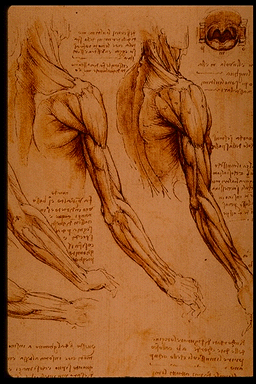
Ever since we have started learning about the Leonardo I was always interested in why he was so famous and was called a genius. After I had left the amazing exhibition I have become very excited about learning more about him and looking deeper into his work. Out of all his unbelievable inventions and art, I thought my favourite work of him are his sketches of the human body; internal and external. However, my favourite sketch of the human body is the picture of the arm muscles. I find how he has drawn each muscle so perfectly and detailed which makes us give us an idea of how complex our body is and it gives us the bigger picture of oursleves. It shows me that Leonardo was a very good drawer and he was a man in the Renaissance how loved to think about the world and questioned and challenged things thought to be impossible.
Saturday, September 26, 2009
Abraham Lincoln

Abraham Lincoln is one of the most famous presidents of the United States of America. Abraham was a very patient man. Even though he was elected president it took him a very long time to do so. When Abraham reached the age of 31 he failed his buisness and the following year he failed to join the Legislative Race. Over the next six years he faced many let downs like having breakdowns, overcoming his lovers death, failing in work and not being elected. You would probably think that he would have dropped everything he started, or have done other things. However, Abraham Lincoln carried on attempting to progress in his work but unfortuantely was let down in the next 20years. Most of these letdowns were from losing congressional races and one time he didn't become the vice president. When Abraham Lincoln turned 60 he was elected president for America and led the country through the Civil War. Abraham Lincoln was extremely patient during his middle years and kept himself together because he believed in himself and it that it would all work out in the end. It shows that people can do things if they work hard and proves that good does come out of everything.
Thursday, September 24, 2009
Patience is a Virtue
Patience
Patience gazed upon a sea of sand,
Bearing only what she had worn yesterday.
Blowing sanguine kisses to what she is waiting for.

Paulo Coelho has used patience to symbolize love and it's moral to the world. In 'The Alchemist' patience is represents itself through Fatima. Fatima is a woman of the desert and a woman of the desert is extremely patient because they must wait for their men to return for long periods of time. This demonstrates that everybody can be patient even when it occurs through a difficult time. Patience is represented through Fatima and she carries out the qualities and aspects of Patience. In three main religions, Christianity, Judaism and Islam, patience is included in their virtues in life. In Christianity, patience is considered one of the most valuable virtues of life and is included in the 'Seven Virtues'. In Judaism, patience is conspicuous theme in Judaism. Jews also have strong patience in God. In Islam, it is believed that if you are patient, you are closer to Allah. Observing that patience is powerfully connected to the main religions, Santiago can use it to become closer to God. Altogether, patience is also to compel people to become a better person and to become closer to God.
Patience gazed upon a sea of sand,
Bearing only what she had worn yesterday.
Blowing sanguine kisses to what she is waiting for.

Paulo Coelho has used patience to symbolize love and it's moral to the world. In 'The Alchemist' patience is represents itself through Fatima. Fatima is a woman of the desert and a woman of the desert is extremely patient because they must wait for their men to return for long periods of time. This demonstrates that everybody can be patient even when it occurs through a difficult time. Patience is represented through Fatima and she carries out the qualities and aspects of Patience. In three main religions, Christianity, Judaism and Islam, patience is included in their virtues in life. In Christianity, patience is considered one of the most valuable virtues of life and is included in the 'Seven Virtues'. In Judaism, patience is conspicuous theme in Judaism. Jews also have strong patience in God. In Islam, it is believed that if you are patient, you are closer to Allah. Observing that patience is powerfully connected to the main religions, Santiago can use it to become closer to God. Altogether, patience is also to compel people to become a better person and to become closer to God.
Subscribe to:
Posts (Atom)
